
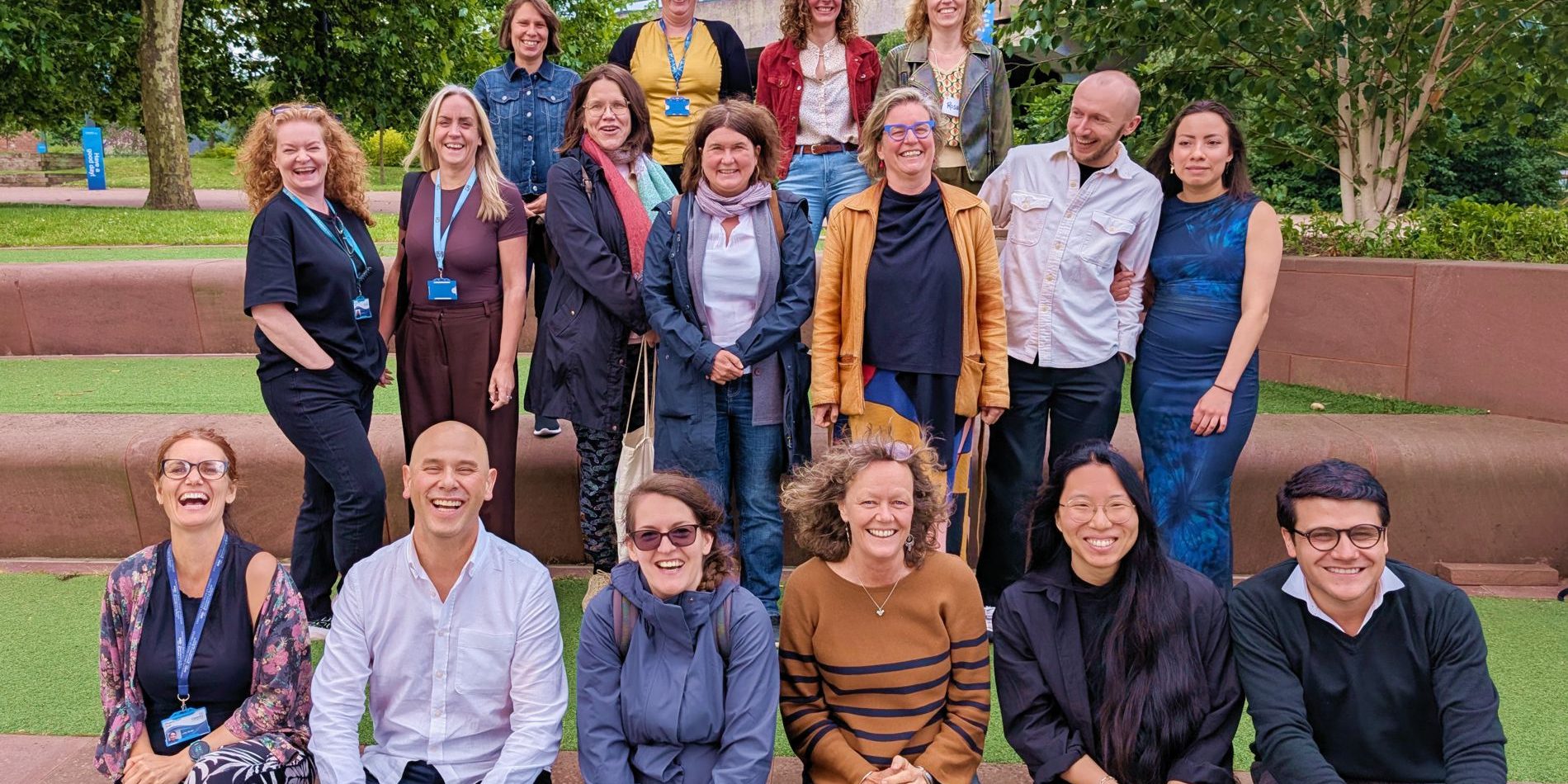
Coventry, UK — 11 June 2026. What does it take for people to truly care about nature? Not just to know that biodiversity is declining, but to feel it, act on it and carry that commitment into the boardroom, the classroom and the ballot box. Despite providing us with food, medicine and clean air, biodiversity continues to decline across the globe. The gap between awareness and action remains stubbornly wide — and bridging it requires taming some very real dragons: the dragons of inaction, disconnection and institutional inertia. On 9-11 June 2026, a new Horizon Europe project took its first step toward doing exactly that, as the DRAGONS consortium gathered for its kick-off meeting in Coventry, UK.
What is DRAGONS?
DRAGONS — Diffusing biodiversity Response-Able Action and awareness raising through citizen empowerment, inclusive enGagement and innovative gOvernance of Nature and Society — is a research project funded under the European Commission’s Horizon Europe programme (Call: HORIZON-CL6-2025-01-BIODIV-09). With a total budget of nearly €3 million, the project brings together partner organisations from seven countries across Europe and Latin America.
“At a time when the biodiversity crisis can feel overwhelming, DRAGONS offers a unique opportunity not only to understand the barriers that stand in the way of action, but to inspire and enable the collective change needed to create more resilient, inclusive and positive futures where nature and people thrive together” – said Jackie Abell, Co-coordinator of DRAGONS from Coventry University.
The Challenge
Despite decades of scientific warnings, biodiversity loss continues at an alarming rate. DRAGONS starts from a simple but powerful premise: meaningful action requires more than knowledge — it requires emotional connection, social inclusion and institutional support. The project’s ambition is captured by a quote from David Attenborough that frames its entire approach:
“No one will protect what they don’t care about; and no one will care about what they have never experienced.”
DRAGONS aims to overcome the psychological, social, and institutional barriers that stand between people and meaningful engagement with nature and biodiversity. Whether it is a restaurant owner rethinking their menu around local biodiversity, a city council embedding nature into urban planning, or a youth group reframing environmental action as a matter of social justice — the project seeks to unlock these changes and then amplify them. This is what the consortium calls response-able biodiversity engagement: emotionally grounded, socially inclusive, and institutionally supported. But the ambition goes further. DRAGONS is built on the principle of diffusion — ensuring that biodiversity is valued in societies and considered as part of the solution to societal challenges (such as climate change, segregation or mental health). It also ensures that what works in places such as Budapest, Bogota or Coventry can travel: through champion networks, media campaigns, policy dialogues and open digital tools, so that local sparks can become systemic change.
Key Objectives
The project is structured around five interlinked goals:
- Understand the diverse perceptions, barriers and tools that shape how different communities engage with biodiversity — including the role of polarisation, misinformation and intersectional inequalities.
- Co-create transformative participatory interventions in governance and institutions, piloted across five Biodiversity Engagement Domains in five countries.
- Develop culturally grounded communication strategies that link biodiversity to health, wellbeing, climate resilience and equity.
- Build and train champions and multipliers — from community leaders to institutional actors — to spread biodiversity-positive practices and narratives.
- Embed findings into lasting legacy tools: the DRAGONS’ DEN knowledge hub, a Champions’ Toolkit, a Spark Fund for emerging biodiversity innovations, and open online courses (MOOCs).
The Consortium
Led by Coventry University (UK) through its Centre for Agroecology, Water and Resilience (CAWR), and co-led by GreenFormation Kft. (Hungary) the consortium includes:
- CTFC – Centre de Ciència i Tecnologia Forestal de Catalunya (Spain)
- Pontificia Universidad Javeriana (Colombia)
- Rare Europe gGmbH (Germany)
- SYKE – Finnish Environment Institute (Finland)
- Wageningen Research (Netherlands)
Associated partners include the Council of the City of Coventry (UK), the Centre de la Propietat Forestal (Forest Ownership Centre) (Spain), Maaseudun Sivistysliitto (Association of Rural Education) (Finland), the Ministerie van Landbouw, Visserij, Voedselzekerheid en Natuur (Ministry of Agriculture, Fisheries, Food Security and Nature) (Netherlands), and the Alcaldía Mayor de Cartagena de Indias Distrito Turístico y Cultural (Mayor’s Office of Cartagena de Indias, Tourist and Cultural District) (Colombia).
What to Expect
Over the coming 36 months, DRAGONS will conduct more than 40 workshops and 50 expert interviews, run media campaigns with a potential reach of up to 2.5 million people, and test over 50 participatory interventions in cities including Coventry, Budapest, Bogotá, Cartagena and Nijmegen. The project will directly engage more than 100 policymakers and produce evidence-based policy briefs and tools to inform EU, national and local biodiversity strategies.
The kick-off meeting in Coventry marked the official launch of the project, bringing partners together to align on governance structures, research methodologies and communication activities for the years ahead.
- dragonsproject.eu
- Bluesky: @dragons-horizon.bsky.social
- LinkedIn: DRAGONS Project
- https://cordis.europa.eu/project/id/101291624

DRAGONS is funded by the European Union under Horizon Europe Grant Agreement No. 101291624. Views and opinions expressed are those of the consortium and do not necessarily reflect those of the European Commission.