If you could stand in your own neighbourhood thirty years from now – and see the version where nature and society recovered and the version where they didn’t – would you make different choices today?
SPARK4B+ is going to find this out in six countries and seven sectors – farming, forestry, water, finance, health, education and cities – from the Bogotá Highlands to German field margins, Galician commons, the Warwickshire catchment, Swedish forests and Budapest’s underused parks and cemeteries. In each place, communities imagine the future they want, models show what it would cost and what it would return, and then the best idea is built and measured.
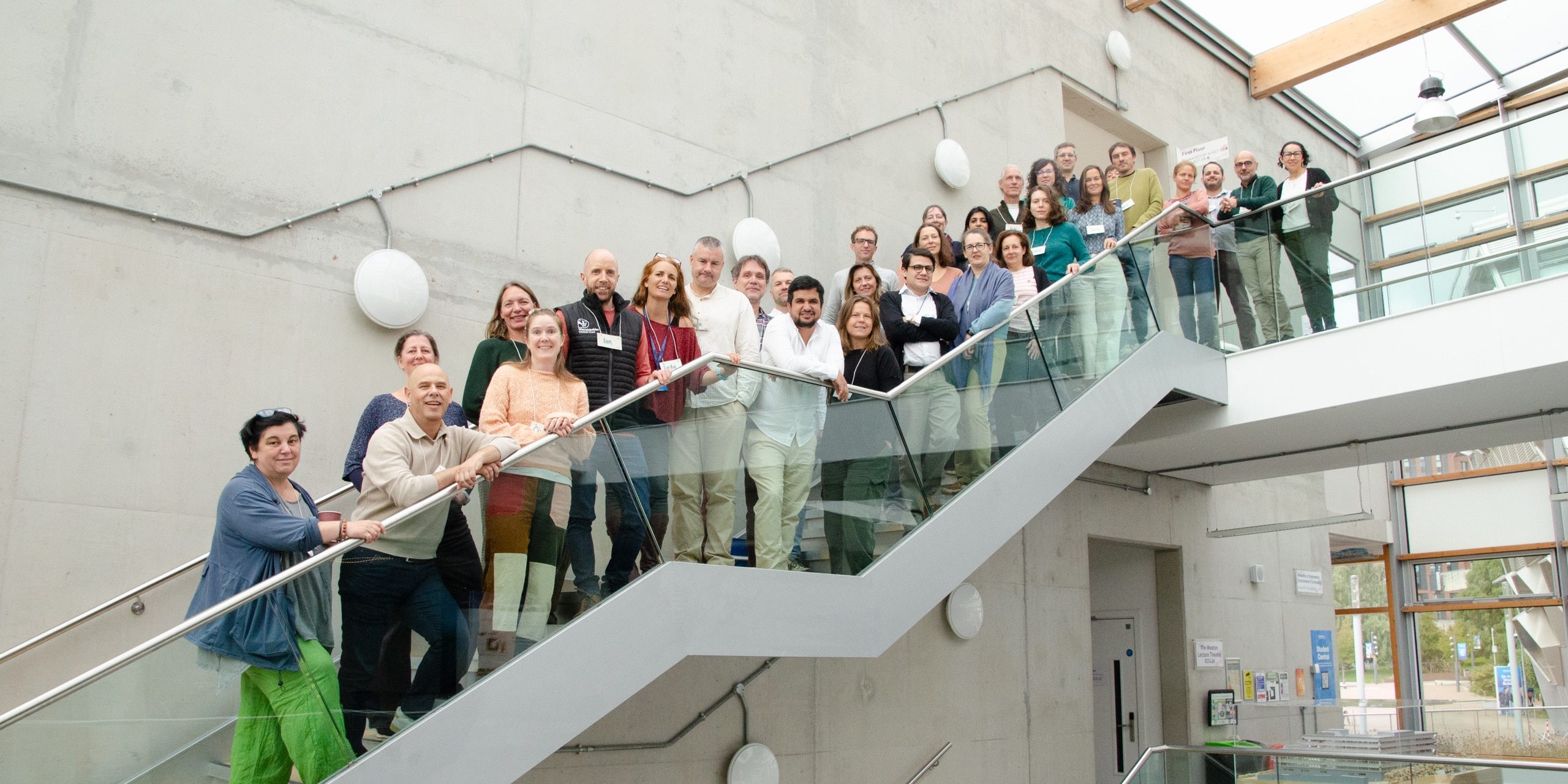
You can’t build what you can’t picture; that’s the premise behind SPARK4B+, a Horizon Europe project launched on 1 September 2026 to turn alternatives to growth-oriented economic models into practical pathways. Backed by nearly €7 million over four years, SPARK4B+ brings together 17 partners from eight European countries and Colombia. The consortium met in Coventry on 8 September for its kick-off.
What is SPARK4B+?
SPARK4B+ (Strengthening Pathways for Alternative socio-economic paradigms and governance frameworks and Response-able Knowledge and action for Biodiversity-Positive and just futures) is funded under the European Commission’s Horizon Europe programme (Call: HORIZON-CL6-2025-01-BIODIV-08).
Strengthening Pathways for Alternative Socio-Economic Paradigms and Governance Frameworks and Response-able Knowledge and Action for Biodiversity-Positive and Just Futures
“Biodiversity loss, climate change and inequality are not separate crises – they are symptoms of the same growth-oriented paradigm. SPARK4B+ gives us the space, the partners and the tools to make credible alternatives tangible, test them on the ground, and turn them into pathways that policymakers, businesses and communities can actually follow”, said Prof. Marco van de Wiel, SPARK4B+ coordinator at Coventry University.
The project starts from the premise that societies stall because the alternatives remain unimaginable. Degrowth, the wellbeing economy, ecosystem-based governance and related practices already exist – but commonly only at small scale, in a fragmented manner, rarely institutionalised, and largely untested. SPARK4B+ sets out to establish them as both visionary and tangible: imagined with communities, tested with evidence, put to work in real places.
From alternative ideas to practical pathways
SPARK4B+ starts by mapping alternative paradigms, and builds the tools to test them: participatory visioning methods linked with biodiversity, climate and economic models so trade-offs become visible. Those tools are then applied in six places, across seven sectors: agriculture, forestry, water, finance, health, education and urban development. In Hohenlohe, Germany, farmers coordinating flower strips and grassland management across farm boundaries rather than field by field. In Galicia, Spain, commons communities managing over a quarter of the region’s land take on invasive species and monoculture. In Warwickshire, UK, blended finance for restoring the Avon catchment. In the Bogotá Highlands, Colombia, agroecological curricula and biodiversity storytelling. In Sweden, forest owners asking whether mixed stands can hold up against drought, fire and pests. And in Budapest, Hungary, under-used parks and cemeteries reimagined as spaces for mental and physical restoration.
Each site runs in two stages: a Transformation Lab where stakeholders imagine a biodiversity-positive and just future, then a Demonstration Intervention where the best idea is trialled and measured – for biodiversity, climate resilience, social equity and economic value.
But a pilot that ends with the project changes nothing. So, SPARK4B+ also builds coalitions meant to outlast the project, champions who carry practices into their own institutions, and communication that reaches past the usual audiences.
A multidisciplinary international consortium
SPARK4B+ is coordinated by Coventry University through its Centre for Agroecology, Water and Resilience (CAWR) and co-coordinated by GreenFormation (Hungary). The wider consortium brings together universities, research institutes, SMEs, civil-society organisations and policy actors from across Europe and Colombia. The project is further supported by an Advisory and Influencers Board, connecting perspectives from Europe, Latin America, Africa and beyond.
The SPARK4B+ project website is live at spark4bplus.eu, LinkedIn and BlueSky.
Media contact
Agnes Zolyomi, GreenFormation [email protected]
Notes to editors
Project: SPARK4B+ (SPARK4Bplus), Grant Agreement No. 101291197 Duration: 1 September 2026 to 31 August 2030 (48 months) Total funding: €6,991,938.75, funded at 100% by the European Union Call: HORIZON-CL6-2025-01, topic HORIZON-CL6-2025-01-BIODIV-08 Granting authority: European Research Executive Agency (REA) Coordinator: Prof. Marco van de Wiel, Centre for Agroecology, Water and Resilience (CAWR), Coventry University More on SPARK4B+ at spark4bplus.eu and on CORDIS: https://cordis.europa.eu/project/id/101291197
The spelling “Response-able” in the project title is deliberate. It refers to the capacity to respond, not simply to responsibility.
The consortium (17 organisations, nine countries):
Coventry University (United Kingdom), coordinator GreenFormation (Hungary), co-coordinator University of Bergen (Norway) ESSRG Nonprofit Limited (Hungary) University of Vigo (Spain) SDSN – Sustainable Development Solutions Network Association Paris (France) Xavierian Pontifical University (Colombia) University of Hohenheim (Germany) European Centre for Social Welfare Policy and Research (Austria) Stockholm Resilience Centre, Stockholm University (Sweden) National University of Colombia (Colombia) AFD – French Development Agency (France) NINA – Norwegian Institute for Nature Research (Norway) Lund University (Sweden) Warwickshire Wildlife Trust (United Kingdom) Montescola Foundation (Spain) Vexiza Limited (Spain)
SPARK4B+ is funded by the European Union under Horizon Europe Grant Agreement No. 101291197. Views and opinions expressed are those of the consortium and do not necessarily reflect those of the European Commission.